
★★★★☆

This review contains strong language and discussion of sex scenes.
What do you do when one aspect of your life collides with another? How do we balance work, cultural identity, family and societal expectations?
Jacky is an urban Aboriginal man with aspirations commonly associated with ‘whiteness’. He wears a sharp suit, wants to own his own home and has a corporate job. He also moonlights as a sex worker.
His life is carefully compartmentalised between his cultural gig work (he performs Indigenous dance and ceremonies), his sex work, and his conversations with family back home on the phone.
He appears to be successfully navigating these differing identities when his brother Keith arrives unexpectedly. Jacky’s worlds begin to collide in a play that is sharp, witty, insightful, shocking and disturbing.
The opening night performance was made particularly special by the welcome to country by Aunty Elizabeth Hayden, who called out to loved ones in the audience and spoke to us all as though we were family. She made the audience feel part of something warm and intimate, but didn’t shy away from truth-telling, describing colonisation as a bomb that decimated her people, and whose fallout is still reverberating today.
It was an apt introduction for a play that explores the damaging effects of capitalism and exploitation of indigenous people. It was also affecting to witness the responses of the big mob of black fellas who attended. (One lady hilariously shouted out “Owee look out!” when things started getting sexy between Jackie and Glenn.)

Playwright Declan Ferber Gillick has crafted a play that is deeply contemporary and takes a clever look at the dichotomy between indigenous culture and capitalism, black and white, individuality and community.
The characters are complex and nuanced – the white characters are liberal and well-meaning, but their benevolence is exploitative, transactional and ultimately damaging to Jackie’s standing in his community.
The black characters are beautifully authentic, complex and well-drawn. Jacky successfully straddles both black and white worlds until they collide and he has to make a choice between capitalism and community.
Furber’s sharp, witty dialogue offsets the shock value of the sex work scenes nicely. Glenn’s fetish for ‘Big Black Cock’ becomes a hilarious verbal gag that is repeated throughout the play, eliciting constant mirth from the audience.
What makes this play so wonderfully contemporary is that Jacky and Keith’s gay identity is not really an issue. Neither of them has to deal with homophobia within the world of the play. It’s as though the other characters’ responses to them are a reflection of a world which is much more at ease with homosexuality.
The sex scenes are natural and funny, not sordid and sensational. Keith tells Jacky the whole family know about his sexuality and were just waiting for him to find the guts to tell them.
This is a play of its time – confident, progressive and putting the boot into conservative audiences – urging them to grow up and get with the program.

Ian Wilkes as Jacky exerts a confident physicality on stage. He has a commanding presence and an ease within himself that transmits a comfortability within the white world he inhabits. He performs Jackie’s sex work and his culture work with an innate sense of professionalism and appears to be comfortable with the commodification of his body in all work spheres.
He has great chemistry with Steve Turner, who plays his client Glenn, and both actors perform the sex scenes with ease and grace. Their connection appears to be genuine – which makes the climactic scene all the more disturbing and uncomfortable.
Wilkes is immensely charismatic and likeable as Jacky. His reaction to the mounting stress and tension, however, is a little too casual and understated, which diffuses the dramatic tension and momentum of the play. His presence is strong, but there is room for his vocal ability to grow.
Steve Turner is terrific as Glenn. His comic timing is impeccable and his delivery of his lines nuanced. Turner is a seasoned performer who is always a joy to watch onstage. He has an easy command of the material and tackles a challenging script adeptly, portraying his character’s fetishisation of the black body and growing feelings for Jacky with humanity and complexity.
Amy Mathews is engaging as Linda, who gets Jacky into a corporate position in order to help him buy a house. Linda appears to be full of good intentions but ultimately manipulates Jackie into betraying his values and community.
Ferber Gimmick has created a complex contemporary character in Linda, who asks her ex-husband how he’s going with the ‘Big Black Cock’ issue without blinking an eye.
The ease all the characters display with sexuality is refreshingly contemporary and hilarious, signalling a new turning point in our contemporary understanding of sexuality.

Newcomer Rueben Mongoo does a terrific job as Keith, delivering Ferber Gillick’s wonderful black fella dialogue with authenticity and charm. He elicits a big laugh from the black fellas in the audience when he employs physical comedy in the pub – doing the hand gesture that signals a request for a hand out.
His larrikinism and black fella humour provide a great counterpoint to Jacky’s slick ‘whiteness’. Mongoo does a great job representing the mob back home – the family member who disrupts Jackie’s carefully curated existence.
Jacky is co-directed by Yirra Yaakin’s Artistic Director Maitland Schnaars and Black Swan’s Kate Champion. Schnaars has elicited the same ease and connection between the characters in Jacky as he did in his last wonderful show, At What Cost?
The relationships feel natural, authentic and comfortable, even as the tension mounts and things go awry. Kate Champion is a director who doesn’t shy away from provocative stories, and her work often displays a keen social conscience. Whoever directed the sex scenes has clearly created safety for the actors in the scenes – they appear natural and at ease with the provocative material.
Sophie Fletcher’s set is a clever metaphor for the compartmentalisation of Jacky’s life and identity. A revolving stage displays the Irish pub where Jacky first worked, the kitchen in his apartment and the generic bedroom of a hotel where he does his sex work.
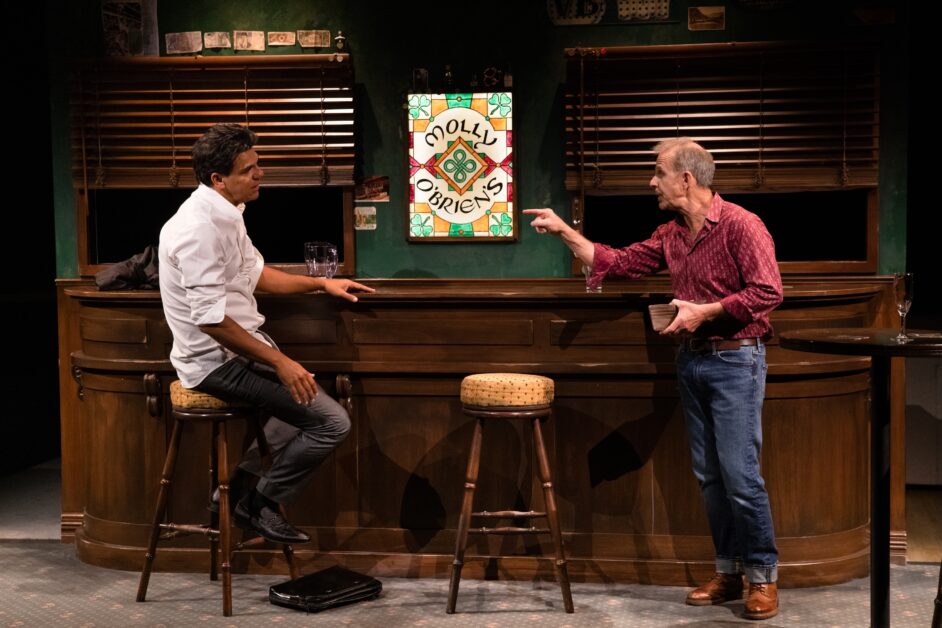
The bedroom and kitchen are clinical and corporate as a nod to the cogs of capitalism turning in Jacky’s world. The Irish pub is a charming reflection of Jacky’s social life but it doesn’t represent an aspect of his identity the way the bedroom and kitchen do.
The set in previous productions at Belvoir St Theatre and Melbourne Theatre Company featured a large corporate desk as a symbol of the direction Linda is trying to point Jacky towards. This seems to be a more appropriate set piece than a pub.
Rachel Dease’s music design notably creates a wonderful effect at the end of a chain gang song from an album Glenn gifts to Jacky, in which the metal clunking of tools echo and reverberate electronically, bringing the slave spiritual into the 21st century.
Jacky is a black man chasing the great white dream. But what does success mean when the system offering him the promise of financial independence is built on the dispossession of his people?
Furber Gillick’s sharp script explores the uneasy intersection of indigenous identity, capitalism and the tension between individual ambition and collective responsibility.
Strong performances and sensitive direction combine to create a powerful theatrical experience, full of humour and complexity. The audience on opening night were vociferous in their praise for Jacky, black and white all rising to their feet together in a thunderous ovation.
Jacky is presented by Black Swan State Theatre Company and Yirra Yarkin Theatre Company and runs to 8 November. Subiaco Arts Centre, 180 Hamersley Road Subiaco WA 6008.
Tickets are available here.
Website: https://blackswantheatre.com.au/season-2026/jacky
Socials: https://www.instagram.com/blackswanstc/
Photo credits: Daniel J Grant





Leave a Reply