
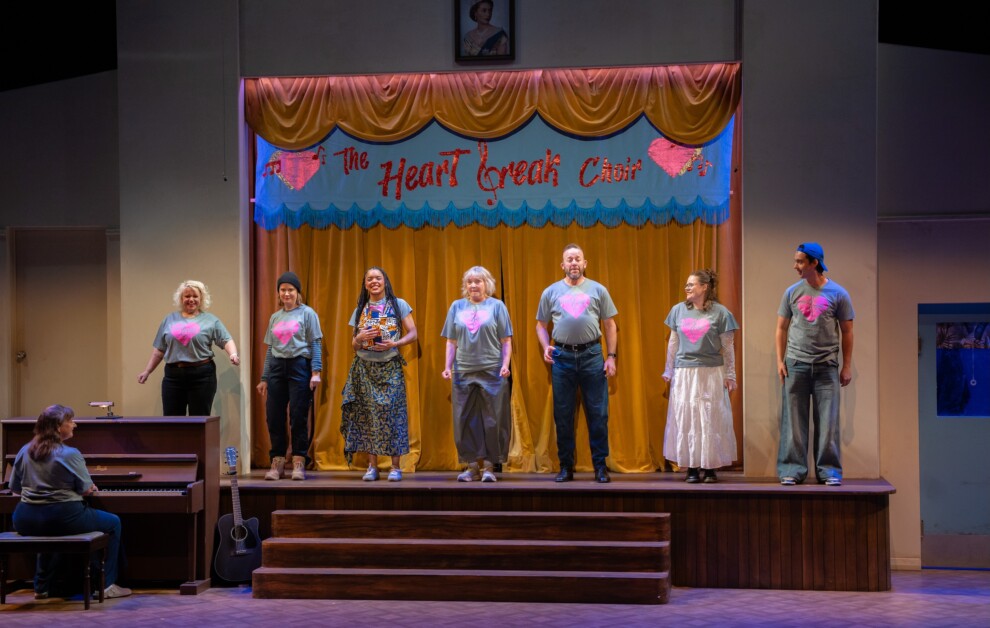
At times, when you sing in a choir and you’re holding your own line, resisting the urge to drift towards the soprano’s melody while listening to the altos hold their harmony, somewhere between you there’s a hum. A ring that lights your soul.
I don’t disagree with the premise of Aidan Fennessy’s The Heartbreak Choir. I’ve been in those old churches that double as rehearsal rooms and know what a life-affirming thing it is to sing with other people. Where we are out of sync is over the question of what you can reasonably ask a song to heal. How can a work about suicide be so emotionally flat?
Tragically, Fennessy died in 2020, two years before Melbourne Theatre Company first staged his final play. In her program note for State Theatre Company South Australia’s production, director Shannon Rush invites us to sing, clap, even dance in our seats. The house lights are up all show. We are part of the choir.
Musical director Carol Young, who runs a community choir herself, has worked with local choirs for the production. Her choir, La La Land, make a cameo at the end of the show.
There are passages of beautiful singing here. There’s also laughs a-plenty in send up of the all-too-familiar experience of trying to get an assortment of vocalists of all ages and musical talents to open their mouths on cue and on pitch.
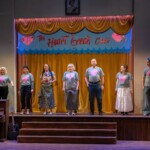
Set designer Meg Wilson knows this hall. A young Queen Elizabeth looks down from above the mustard curtain. She’s been up there since it opened in the ‘50s, gathering dust.
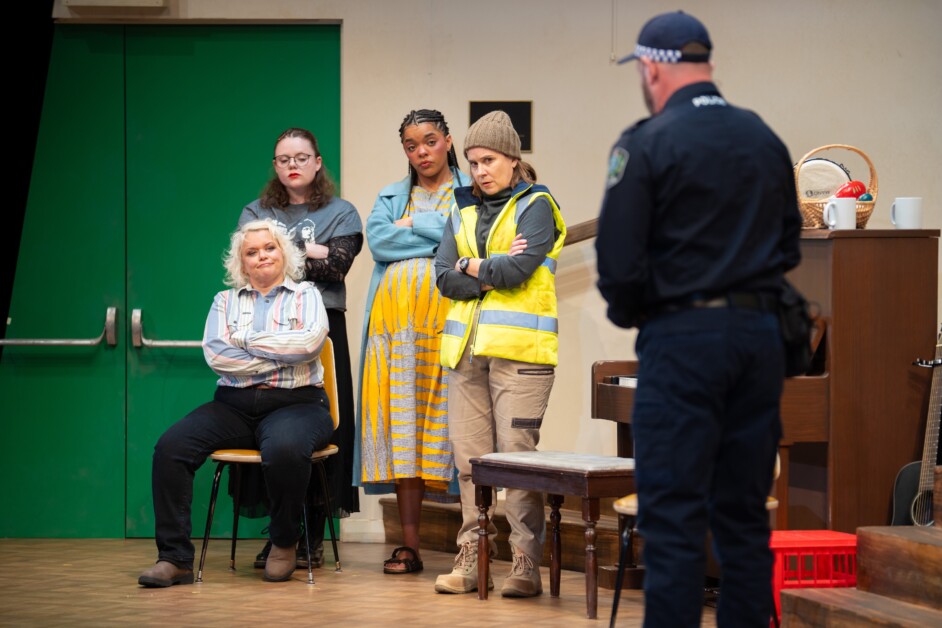
Over in the kitchen, there’s a beige roller shutter that opens up for service. Cans of Coke and Mars Bars for a dollar. Anyone who’s done their time in a community choir knows how much you’re hankering for a 9pm tea and biccie after an hour of bashing notes.
Mack (Libby O’Donovan) takes the catering responsibility beyond the hall. Move to town, and you’ll find a pineapple cake in a box on your doorstep. A cliché with some truth to it. Every town has a Mack. O’Donovan can also bring the house down with a single “fuck me”. The show, for all its flaws, is worth it for Libby’s performance.
Genevieve Mooy’s Barbara sets the tone of the night with her devotion to vocal warm-ups. A lip trill is a stock-standard, though outwardly silly exercise which escalates in hilarity when it triggers vibrations further down the back side of her anatomy.
Rush and her cast, including the endearing debut by Lucia Rose Franks and the iconic voice of Bluey’s Emily Taheny, get the foibles of choir practice wonderfully right. The trouble is that the same people have also been handed the heavy themes of suicide, institutional abuse, civil war, asylum seeking, rural politics and the failings of the justice system.
You can imagine the synopsis on a grant application. Modern life is hard. We’ve got a mental health crisis. Singing and community help. Sounds great. Here’s your grant! Converting an elevator pitch like that, the sort you might find on a government grant application, into a two-and-a-half-hour show with a heart that rings true; that’s harder. It’s too hard for this fine cast and crew to elevate the text to this level.
On stage, much of it unfortunately feels like a sketch show with the social themes gaffer-taped to the side. For example, Mack’s neurodivergent daughter Savannah, played by Billie-Rose Russell. A goth in a room full of chatter, Savannah covers their ears when the talk gets too loud. Sensory overwhelm, accurately depicted.
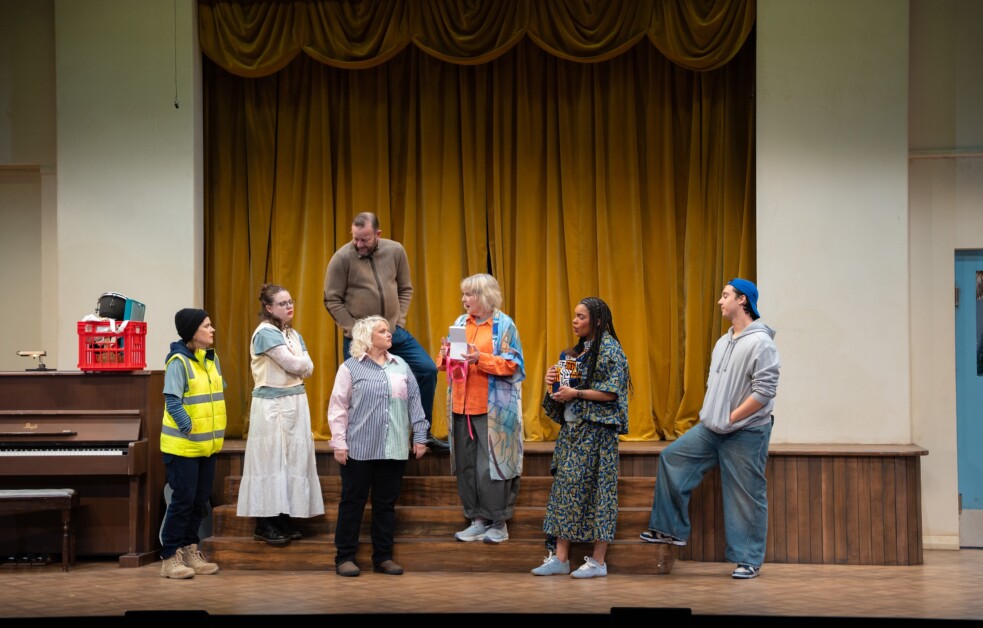
I wanted to know more about choir practice from her perspective. What’s it like to come here for the singing when the conversation can be too much? The script seems satisfied that there’s diverse character representation without sufficiently delving into the reality of experiencing the world that way.
Grief, too, does not seem to be understood. It comes in waves. You can laugh. You can leave the house and go to choir practice. The following week you might not go. You might get halfway through the very same rehearsal and need to go home.
There’s nothing false about writing a comedy about people bereaved by suicide. What rang false for me came early in the second act, when Peter (Mark Saturno) cried in front of his son Beau (Darcy Wain). People in the audience laughed. I couldn’t tell you why they laughed.
Sometimes male expression of emotion is uncomfortable. I think I understood why the tears took them by surprise. I was still waiting for the gag, too. Saturno had been left to do in a few seconds what the writing hadn’t done for him.
You can’t just have moments of loud sobbing with a character’s back turned to the audience to tick the “they’re still living with grief” box. This needs to imbue the dialogue and mannerisms of the characters throughout, not be compartmentalised into isolated moments. We’re not all that good at masking our inner storms.
The most problematic line belongs to Barbara. People who live with someone experiencing mental illness, she says, “have to climb Everest every day”. It is true that perspectives regarding psychosocial disability can differ between the supporter and the supported. The supported doesn’t get a voice in this work, though. They are the deceased. The person who left the others behind. We see the bereaved.
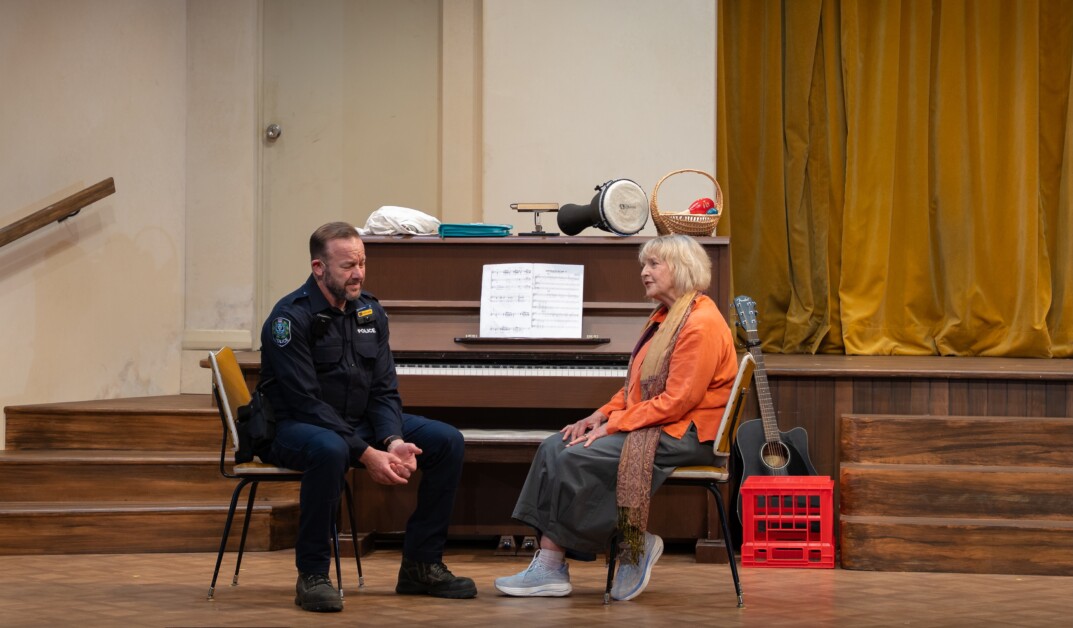
Mental illness itself remains largely out of view, though it’s spoken about. Imagine coming to the theatre already worried about what it costs the people who love you to have you around. What are you meant to take home from being told your loved ones are like Edmund Hilary, who are climbing you just because you are there?
The work’s central thesis about turning the other cheek and singing with those you disagree with is equally fraught. If the institution at the centre of your community has sheltered abusers, there are good reasons to walk away from it and stay away.
Yes, we live in a polarised world, but there are underlying causes for the polarisation: real divides about what our society should look like, what causes should be championed, what changes need to be made.
The solution of “can’t we all just get along and sing” seems too simple. Like a form of bypassing. The work’s message gets muddled and lost as the conclusion piles on twists and conflicting messaging. Bad composition.
So, I laughed at the lip and butt trills. I’d take one of Mack’s pineapple cakes. But when the songs offered their encouragement to sing through whatever breaks you, I thought about the weeks you can’t get yourself to rehearsal.
I wanted some room in The Heartbreak Choir for the person who stays home. By the end, I hadn’t shed a tear. What I felt was anger at how lightly the evening had passed over the people lying in bed in the darkness, staring at the ceiling.
The Heartbreak Choir is presented by State Theatre Company South Australia and runs to 5 December at the Dunstan Playhouse. Adelaide Festival Centre, King William Street Adelaide SA 5000.
Tickets are available here.
Website: https://statetheatrecompany.com.au/shows/the-heartbreak-choir/
Socials: https://www.instagram.com/statetheatresa/
Photo credits: Matt Byrne



Leave a Reply